
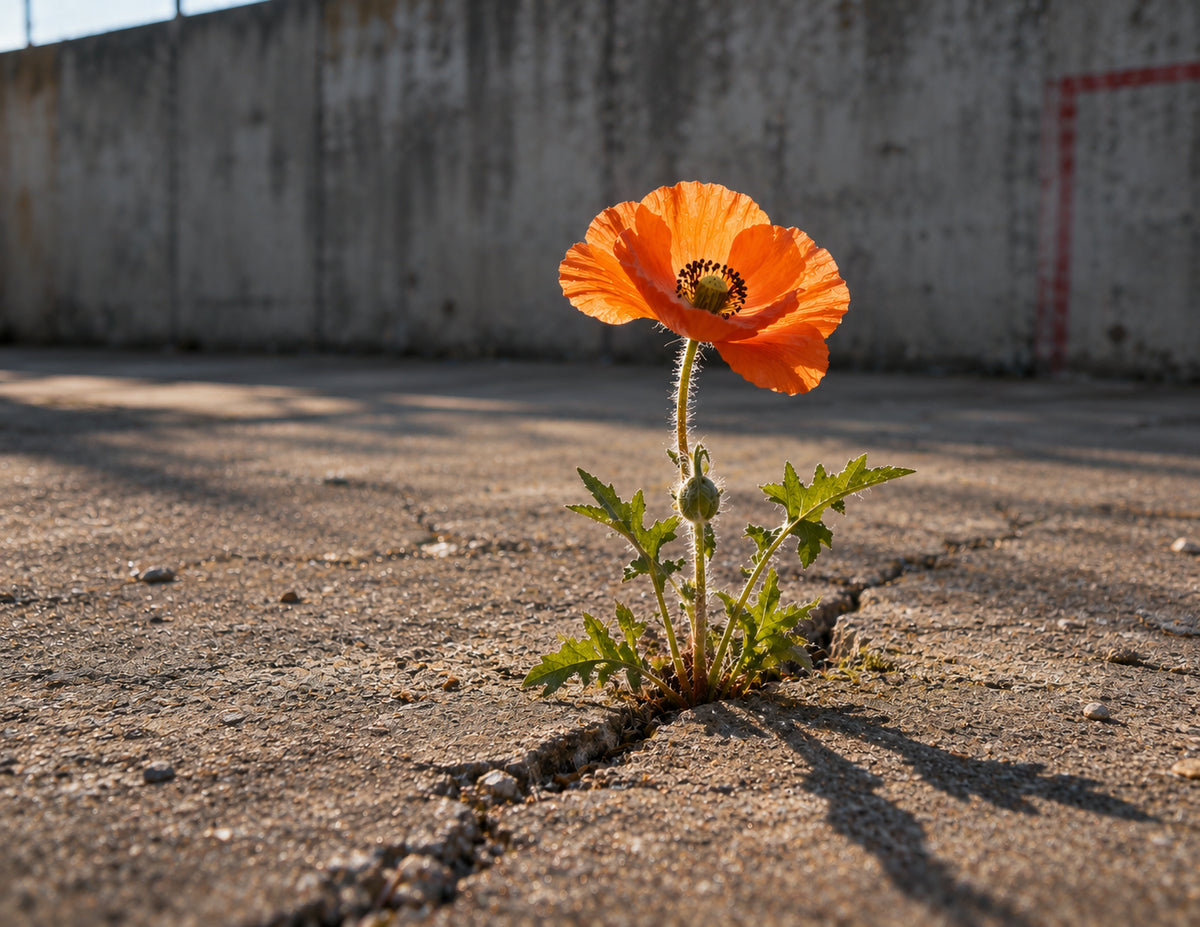
Happening in real time
To be spontaneous in an increasingly artificial, curated,
and performative world is to be a vibrant flower in a concrete schoolyard.
I have a very fast mind.
And it likes to get ahead.
I have had a level of hypervigilance.
Maybe I was born with it.
Maybe it was born in me the moment I was born,
C-sectioned into the world while my mother was under general anaesthetic.
Where is my safety?
However it arrived, I learned that my safety was not in the soil, not in the matter (the word matter shares an etymological root with the word mother).
But in the “air”, in my mental ability to predict, strategise and adapt.
This has gifted me in many ways, sharpened my intellect, made me adept at pattern recognition, foresight and articulation.
But it has cursed me in equal measure.
One of the more subtle but pervasive ways it affected me was through a lightning-quick ability to manufacture a response to people and circumstances from the top down.
I did this by creating a projection from my mind alone and then performing that projection. Rather than being moved to expression by my bodily signals.
I wasn’t necessarily ever being dishonest,
but could I be fully genuine when I wasn't genuinely expressing what I was feeling?
I did not allow for time, nor the capacity for feeling. Feeling was like an inconsequential oddity that needn’t be a part of the main production.
The production of: How do I best survive this situation intact and favourably?
I developed the capacity to anticipate the situation rather than the capacity to meet it.
This getting ahead of myself meant that I was blocking the opportunity for my true nature to reveal itself. It led me to try to manipulate my experience rather than participate in it.
Then chaos arrived. I lost my father and sister to cancer in quick succession.
This broke down, well, everything, including all of the structures and mental patterns that I had been living through.
It was like I was driving a car, with my nose pressed up against the steering wheel. And I had a head-on collision that thrust me into the back seat of the car. Where I sat, stunned, and to my surprise, the car kept driving. In one sense it liberated me. I saw how much life unfolded without my control and will.
On the other hand, it was unsettling.
I watched myself perform. I saw how I had scaffolded together a personality based on people I thought were liked, confident, admired.
As I healed, I quested for authenticity.
First looking outside, thinking that’s where I needed to find it.
By having authentic pursuits.
And to a degree, I was right.
But that was only one half of the equation.
The other half was inside me.
Turns out my feelings and emotions are slow, deep and nuanced. I am very sensitive to the feelings of others, and I often feel what's going on around me before I feel what's going on within me.
I began to learn that my inner experience requires presence and patience,
two of my mind’s least favourite things.
As I continued to develop my capacity to be with the fullness of my physical experience (an ongoing journey), I began to lose control (my mind’s third least favourite thing).
This didn’t necessarily make me more chaotic, but it did make me more transparent, less polished, more vulnerable, flawed and emotive.
Now, as I write this, I am leaning into recovering my natural spontaneity, which is to say, to allow myself to happen in real time, to be alive in participation with the moment I am in.
Nature is spontaneous. It’s not something I need to create; it’s something I need to allow.
The flower does not decide it wants to be a rose before performing its petals.
It responds to the sun, the space, the climate, and it expresses as much of its nature as it can within those conditions, spontaneously.
To the flower, its fulfilment is in its expression.
To a bumblebee it offers sustenance.
And to a curious child in a concrete schoolyard,
it is beautiful.
Until the next time,
peace and love
Alex

2 comments
Really enjoy your reflections
Barbara
It’s me again (I wrote to you encouraging you to mention the science behind the efficacy of your product, I’m absolutely neurodivergent).
Just had to say I felt a little sad to read this email about your learned hyper-vigilance as I could absolutely relate.
The ‘sad bit’ being that hyper-vigilance, predicting, strategising, adapting, the capacity to anticipate the intent of others or their emotions, typically stems from surviving a stressful childhood home. Quite often the volatile emotions of parents or older siblings made it difficult to get through a day, nevermind to process or validate our own perfectly formed & appropriate feelings. Gauging the ‘right mood’ of my own family, meant the difference between being belittled & actually being heard.
The feelings of my family members were so large, that no matter the size of my own, they would ALWAYS pale into insignificance. Which I believe has led to geographically distancing myself from them. They’re well rounded kindhearted adults these days, compared to the 70’s. But I know my place in times of ‘crisis’. I’m not valued, respected or appreciated by them when it really matters. I’m not built to fight it, it hurts too much. I tell my psychologist, who affords me the true kindness I deserve. It’s sad I need to pay someone to be nice to me but I also know she means it, because my intuition is, second to none.
Another likely ‘hangover’ from my childhood. It’s served me very well.
Wishing you and all others, immense healing from your past.
Clare
Leave a comment
This site is protected by hCaptcha and the hCaptcha Privacy Policy and Terms of Service apply.